The full picture

Evidence & sources.

Read the studies, check the records and see what remains unresolved.

Del Mar is the wrong place for pickleball. Keep it for tennis and protect the homes around it. Establish full costs and funding before further commitments.

What’s at stake. Nearby homes should not suffer the noise. Members should not bear avoidable costs from a decision made before its consequences are evaluated. The tennis courts should not be compromised with excessive striping and disruption.

Now available for comment: Read the published Resolution 626 (PDF). The Board approved publication on October 24, not final implementation. A final decision is expected in December. Read the changes and unresolved concerns below.

Start with these three sources.

EXISTING CAPACITY

Existing capacity could spare tennis and nearby homes.

Moonraker has
substantial spare capacity.

Use existing capacity before imposing more noise and expense on another neighborhood.

68%
available to book
325 of 477 court-hours across all three courts, October 6–20

The three Moonraker pickleball courts offer an existing alternative that deserves priority.

Make full use of Moonraker’s three pickleball courts before committing more money at Del Mar. Our snapshots show substantial advance availability; actual attendance remains unknown.

Protect Del Mar’s tennis courts from permanent pickleball changes.

Permanent pickleball lines would add competing markings to the tennis surface and further entrench shared use. The Board should not approve permanent striping before evaluating neighborhood impacts, the effects on tennis, full costs, and whether Moonraker’s existing capacity could meet demand.

Tennis players would lose booking freedom.

The published version of Resolution 626 would allow tennis reservations on Court 2 only when Court 1 is unavailable, while adding permanent markings for two pickleball layouts. Tennis remains permitted, but its players face a new booking restriction and a more cluttered playing surface.

Evaluate wet-condition slip-and-fall concerns before adding permanent markings.

Additional painted lines raise a court-safety question that should be evaluated before permanent striping. Traction depends on the specified paint, surface preparation and texture. USTA guidance calls for textured line paint; suitable court-line products are designed to match the surrounding surface’s traction. More lines alone do not prove a slip hazard, and no site-specific test of Del Mar’s proposed materials is presented here. Require product specifications and a wet-traction review before installation.

Read the evidence on striping, disruption and damp-court safety

Keep the lines clear.

Additional court lines create a busier playing surface. The USTA identifies sport-specific facilities as the ideal solution; when courts must be shared, it calls for carefully designed, subdued blended markings. Markings removed fully before tennis avoid that particular visual conflict.

Protect the playing experience.

Pickleball’s repeated paddle impacts affect more than nearby homes. USTA Southern documents tennis players’ concerns about pickleball noise during play. Del Mar’s tennis players should not have to accept disruptive noise as the price of access.

Take damp-court safety seriously.

Extra markings need a materials-specific safety check: grip when damp, secure attachment and compatibility with the court. Some inappropriate paints can be slippery when wet; proper textured court paint is designed to preserve traction. Temporary tape or strips should never be assumed safe without checking the actual product and conditions.

Preserve dedicated tennis courts. That avoids these additional compromises. USTA guidance calls for suspending play when courts are wet and slippery. No site-specific test has established that Del Mar’s proposed marking material is unsafe; the point is to resolve the risk before use.

Shared use brings competing demands, extra lines and noise during tennis. Preserve Del Mar’s tennis courts and playing experience.

Keep the tennis surface free of unnecessary added markings. Any proposed product needs checks for wet grip and secure attachment before use.

Current proposal · published for comment

What changed, and what remains unresolved.

On October 24, the Board approved publishing proposed changes for a 28-day comment period. It did not give final approval to implement those changes. The published version is now available, with a final decision expected in December.

Protective measures were cut because of review and permitting concerns.

The earlier draft included extending the west-side fence to carry acoustic screening, relocating the Del Mar backboard and building a replacement at Ohlson, and adding portable ball-containment barriers. Those three items are absent from the published version. At the hearing, the chair linked their removal to concerns about County permits or environmental review.

Removing protection because it requires permits does not remove the noise. The responsible course is to establish whether the measures will work, fund them and obtain the required permits before proceeding. Engineering and permitting go directly to the feasibility of the promised protection and whether Del Mar is suitable.

Neighbors raised concerns about whether these measures were feasible. Removing proposed protections in response to those concerns creates an appearance of retaliation, leaving neighbors facing the very impacts they asked the Board to address. The Board should address that concern through independent review and the requested mediation.

Compare the published PDF with the earlier draft, page 2. The chair’s explanations occur at approximately 2:04:54–2:05:54 and 2:22:04–2:23:13 in the full October 24 Board recording.

Mitigation theater, not a workable protection plan.

Acoustic fencing / wind screening on existing chain-link fencing and quiet loaner paddles and balls remain listed, dependent on staff time and resources. The resolution requires no acoustic study, performance target, completed protection before striping, mandatory quiet-equipment use or enforcement plan. It also provides no complete budget or specific mitigation funding. Existing fences need a structural assessment before added screening can be assumed safe and feasible.

Acoustic panels can turn a noise problem into a safety problem.

Solid coverings increase the wind load on an open chain-link fence. The professional study prepared for the City of Centennial warns that standard court fencing may not be rated for that load and could collapse in high winds. It calls for consultation with the fence manufacturer or a structural engineer before attaching solid acoustic material; reinforcement may be needed.

The same study says ordinary wind screens should not be treated as noise abatement. Resolution 626 describes “acoustic fencing” / wind screening without specifying performance, structural requirements or a tested design. A product label is not proof of noise protection, and an existing fence is not proof that it can carry the added load safely.

It changes tennis access without resolving the need.

Permanent markings for two pickleball layouts remain proposed on Court 2, and tennis reservations there would be allowed only when Court 1 is unavailable. The resolution itself says there is generally no capacity issue, but requires no comparison of Moonraker access improvements and other alternatives before permanent changes.

The same assurances remain in the findings.

The County finding still describes additional striping, although screening, equipment and a storage shed remain proposed. The Board should identify what County advice covers the actual scope. Historic play and the absence of significant recorded complaints do not measure noise or predict the effects of future use.

Members are being asked to support permanent changes before the resolution establishes effective protection, a complete cost or a fair comparison of alternatives.

Historical background · before the October 24 hearing

What the earlier proposal included.

The Board changed the proposal during the October 24 discussion. This comparison describes the pre-hearing draft, not the revised version published for review.

Open the earlier proposal and supporting-document comparison

The pre-hearing draft proposed:

  • Permanent markings for two pickleball layouts on Del Mar Court 2.
  • A new restriction on tennis reservations for that court.
  • Rolling pickleball nets and portable ball-containment barriers.
  • Extension of the west-side fence and acoustic screening.
  • Backboard changes, ball machines and other equipment purchases.

The striping directive stands on its own. The additional measures depend on staff time and resources. Nothing in 626 requires the Board to demonstrate that neighbors will be adequately protected before permanent striping proceeds.

The 65-page pickleball excerpt contains agenda PDF pages 32–96. Resolution 626 appears on pages 95–96. These documents preserve the original proposal and supporting material; they do not show the changes made at the hearing.

The safeguards discussed in the packet are not all in the resolution.

Members could read the supporting materials and assume mandatory quiet equipment, temporary markings and other protections are part of the decision. Resolution 626 does not adopt those separate proposed rules. It does not itself establish mandatory equipment use or an enforcement plan. This comparison does not determine which existing rules remain in force; the Board should state that explicitly.

IssueSupporting proposalsResolution 626
Quiet equipmentGina’s proposed rules require Quiet Category paddles and balls and describe enforcement.Authorizes quiet loaner purchases; does not itself establish mandatory use or enforcement.
Court markingsTemporary markings.Permanent striping.
Pickleball layoutsOne per tennis court.Two on Del Mar Court 2.
Decision processNotice memorandum recommends separate consideration of markings and usage rules.Combines facility changes and reservation provisions in one resolution.

Members deserve to know exactly what protections they are getting, rather than discover after approval that reassuring language was only background material.
NEIGHBORHOOD QUIET

Neighbors could lose quiet enjoyment of their homes.

Pickleball noise is
a nationwide problem.

Communities across the country have faced persistent complaints, disputes and court closures over repetitive paddle noise near homes. Del Mar should learn from those experiences before neighbors and members pay the price.

Noise does not stop at the edge of the pavement.

The pre-hearing supporting memo predicted no significant environmental or ecological impacts because the changes occur on paved surfaces. That does not establish what nearby residents will hear. The Board needs evidence about sound reaching homes and the effectiveness of its proposed mitigation.

The pre-hearing draft required no site-specific acoustic assessment before striping proceeded. Residents should not have to suffer a disturbance first and then fight for relief.

When Conversions of Tennis Courts to Pickleball Courts Present Problems

These selected examples concern existing tennis courts where studies identified noise problems or recommended changes. They are not a representative sample of all conversions, predictions for Del Mar, or universal legal standards.

La Cienega Tennis Center, Beverly Hills, California

A pilot used existing tennis courts with pickleball overlays and portable nets. After noise concerns from residents and tennis players, the City obtained sound measurements and modeling before settling on a permanent configuration. Its August 5, 2025 staff report said pickleball on Court 1 exceeded the County noise standard used in that analysis. Staff recommended returning Court 1 to tennis and relocating/reconfiguring pickleball on other existing courts.

The recommended configuration was modeled to reduce residential noise within that standard. This was a case for changing the location and layout, not a finding that pickleball was unsuitable everywhere at the facility.

Rosenfeld Park, Tucker, Georgia

Pickleball was already being played with portable nets on existing tennis courts when the City studied a proposed renovation with dual-use courts. PSM Consulting’s August 27, 2025 report modeled sound exceeding its recommended target at nearby homes. It found that increasing barrier heights alone would not adequately control the sound and recommended against constructing pickleball courts according to the proposed design.

The report considered alternatives including an acoustically treated enclosure or a redesigned layout with courts dedicated to one sport. Its target was a consultant recommendation for that site, not a universal legal limit.

The lesson for Del Mar: study the actual site and proposed design before making permanent commitments.

Quiet matters beyond nearby homes. People come to Del Mar to enjoy yoga, gardening and swimming, too. Those activities deserve a peaceful setting.

Martinez, Carmel-by-the-Sea, Lake Oswego and Boise have ended pickleball at specific courts following neighborhood noise disputes. The lesson is clear: residential compatibility belongs at the beginning of the decision.

Equipment ratings alone cannot establish whether pickleball is appropriate next to homes. The Board should address Quiet Communities’ court-conversion guidance and obtain an independent, site-specific acoustic assessment.

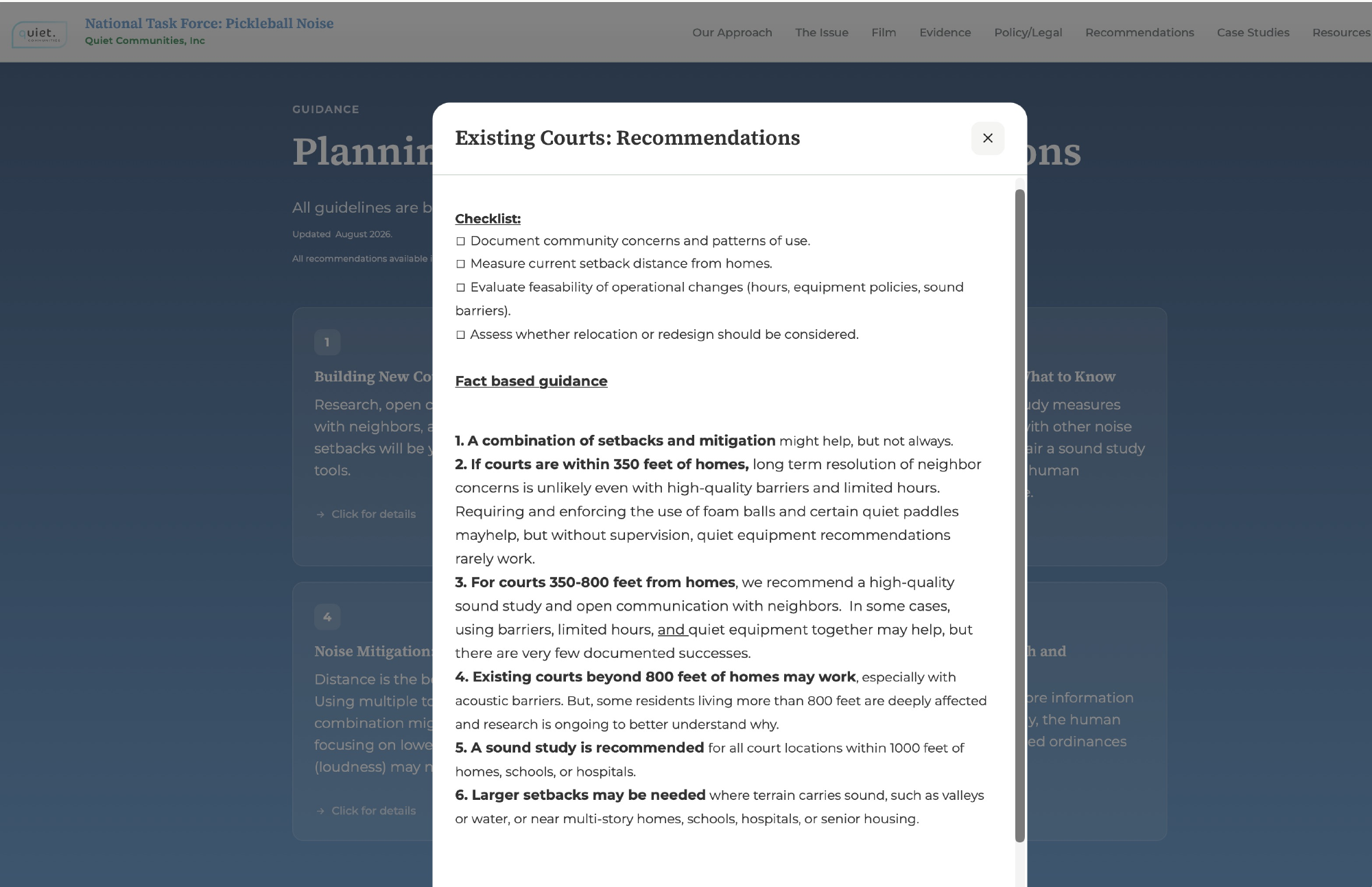
What the existing-court guidance says

Recommendations from Quiet Communities’ National Task Force on Pickleball Noise:

Within 350 feet

Lasting relief is unlikely, even with high-quality barriers and shorter hours. Quiet equipment needs supervision.

350–800 feet

Commission a sound study and consult neighbors. Combined measures may help, but documented successes are few.

Within 1,000 feet

A sound study is recommended near homes, schools or hospitals. Even beyond 800 feet, some neighbors remain affected; terrain can require greater separation.

Distance matters. A promise of quieter equipment is not a substitute for evaluating the site.

Preview the original one-page guidance
Quiet Communities and the National Task Force on Pickleball Noise: Existing Courts recommendations, August 2026
Existing Courts: Recommendations. Quiet Communities / National Task Force on Pickleball Noise, August 2026. Original guidance graphic supplied by concerned homeowners; select it for the PDF. These are recommendations, not binding legal standards. Read the current full checklist.

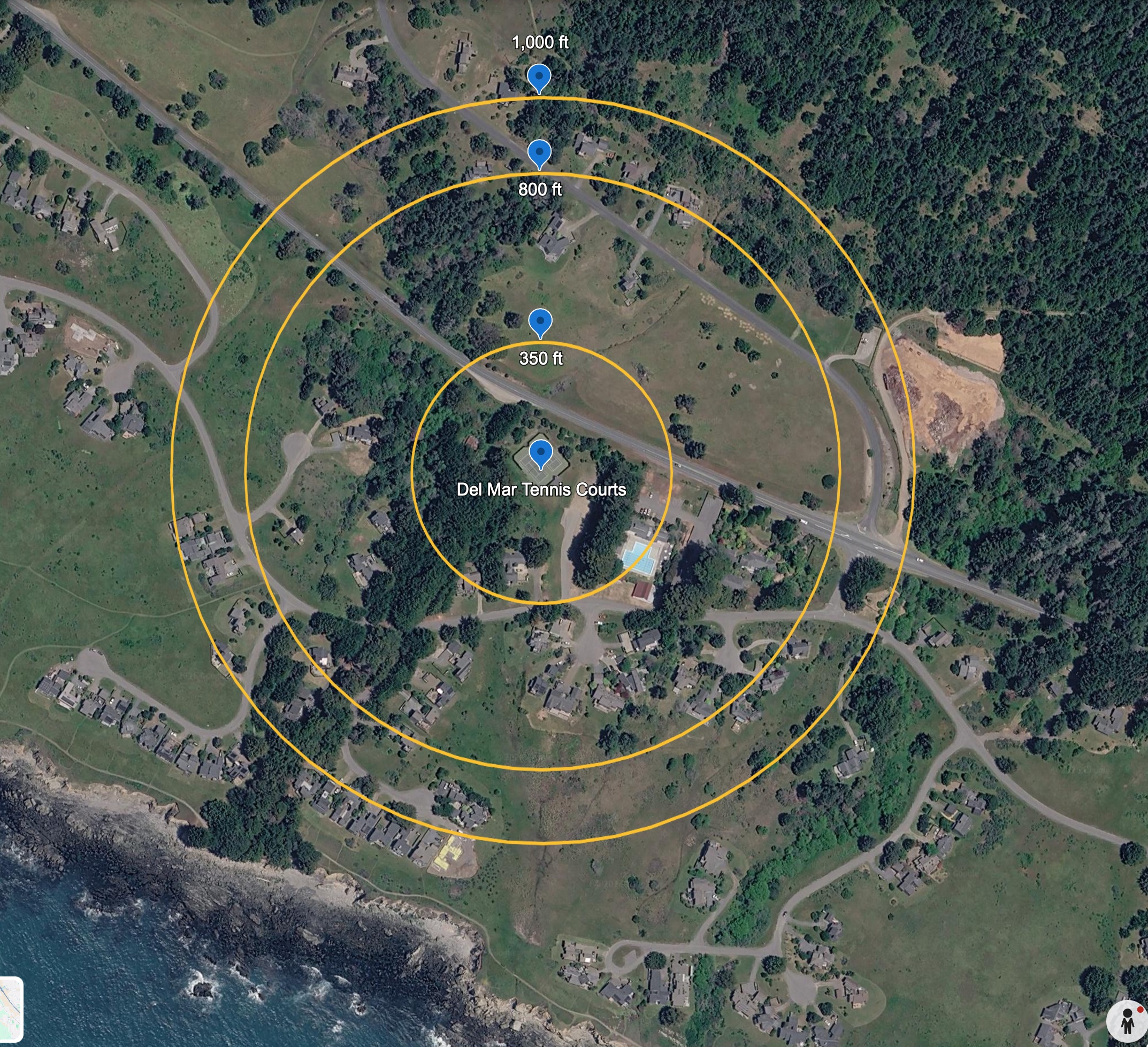
Keep repetitive paddle noise away from homes. The distance exhibit shows just how closely Del Mar’s courts sit among residences.

The neighborhood
is already here.

The aerial exhibit shows homes around Del Mar’s courts and reference rings at 350, 800 and 1,000 feet. These are the distances that make responsible siting so important.

View the full-size aerial exhibit
Aerial distance exhibit from Concerned Sea Ranch Homeowners: yellow rings labeled 350 feet, 800 feet and 1,000 feet around Del Mar Tennis Courts, with surrounding homes visible.
Potential pickleball noise impacts on nearby homes. Distance rings shown for reference. Graphic shared by Concerned Sea Ranch Homeowners.

Protect your
property values.

Protect the peace and quiet people expect at home. Persistent court noise can turn prospective buyers away. Nearby homeowners should not carry that avoidable risk for a recreation decision made by the Association.

Read the property-value evidence and documented court closures

The National Association of Realtors reported a Michigan sale where prospective buyers objected to nearby pickleball noise and the home eventually sold below its original asking price. That example is a warning about marketability, not a measure of a standard loss in value. Protect residents’ enjoyment of their homes and avoid creating a preventable resale risk.

Property-value sources and limits

Evidence is mixed and location-dependent. The same NAR article describes another home near courts selling above asking. An appraisal presentation in Lake Bluff reviewed 11 nearby sales and found no apparent depreciation; officials questioned the sales period and missing information about court use and noise mitigation. Neither a small study nor an isolated below-asking sale establishes a general causal effect or a reliable percentage loss. No Del Mar property-value study is presented here.

Communities that stopped pickleball near homes

These are documented closures at particular sites, rather than citywide bans. The records cite noise and neighborhood compatibility. They do not establish that officials proved property-value losses or closed courts specifically to prevent them.

Do not expose neighbors to avoidable resale risk. Court noise may deter buyers; no Del Mar study establishes a specific loss in value.

ASSESSMENT BEFORE COMMITMENT

A complaint log is no substitute for an acoustic assessment.

No complaints is not
a noise assessment.

A complaint log records reports; it does not measure sound at nearby homes or demonstrate that future use will be compatible with the neighborhood.

A decade of play is not a decade of professional evaluation.

Past complaints tell us what was reported under earlier conditions. They do not establish the effects of future playing levels, permanent markings or easier setup. A professional assessment can evaluate those conditions before neighbors are exposed to them.

Past play and the absence of reported complaints cannot substitute for an independent, site-specific acoustic assessment. Evaluate expected play, nearby homes, terrain and any proposed mitigation before further permanent changes.

Indian Wells studied the impacts—even with homes 500 feet away.

The City commissioned an acoustic assessment for proposed pickleball courts approximately 500 feet from the nearest homes, across Highway 111. Consultants measured background sound, tested how sound traveled across the site, and modeled future play and mitigation. They evaluated the impacts before the courts were operating.

The study predicted compliance with local residential noise limits and found that quiet paddles reduced sound, while warning that repetitive impacts could remain audible and annoying. Those findings reflect a resort setting influenced by highway traffic. Sea Ranch’s quiet coastal neighborhoods deserve an assessment of their own conditions. With homes closer to Del Mar, TSRA should establish whether its proposed measures will adequately protect neighbors before making permanent commitments.

What must be resolved before permanent pickleball proceeds?

Follow the required process before committing members’ money. Notice, Design Committee review and permitting are distinct questions: satisfying one does not establish compliance with the others.

1. Give members the required notice.

The pre-hearing draft included a restriction on tennis reservations on Court 2 when Court 1 was available. California Civil Code §§4340–4360 generally requires 28 days’ advance notice for covered operating-rule changes governing common-area use. Notice must include the proposed rule text and its purpose and effect; the Board must consider member comments before deciding.

Resolution 626 was published for review rather than adopted on October 24. The Board should clearly identify the revised text, comment deadline and next decision date. A review period is useful only if members can understand the actual proposal and the Board considers their input.

2. Document Design Committee review.

Sea Ranch Restrictions §3.07(b) requires the Association to submit plans for covered common-area alterations to the Design Committee, subject to specified exceptions. The Board should disclose the approval record for permanent markings, fencing and other proposed alterations, or identify the exception on which it relies.

The Restrictions also contain provisions for deemed approval and specified reconstruction or refinishing work. Requesting the complete review record is not the same as asserting that no approval or exception exists.

3. Confirm permitting for the complete project.

The earlier draft described the County’s position in terms of striping while also proposing fencing, acoustic screening and other physical work. The Board should obtain and disclose confirmation of the building, coastal and other approvals or exemptions applicable to the full project. A conclusion about striping should not be presented as clearance for work outside the scope reviewed.

The Coastal Commission explains that coastal development is broadly defined and generally requires a permit unless an exception applies. The appropriate agency must determine how the requirements apply to the actual proposal; this is not a finding that every proposed component requires a new permit.

Why this matters to all members

Failure to satisfy applicable requirements can lead to challenges, legal expense and the cost of correcting or undoing work. These are potential risks, not a finding that TSRA has violated the law or that liability is inevitable. Defer permanent commitments until the notice, design-review and permitting questions are resolved and documented.

Solar project: what TSRA’s records show Jump to this section

Resolution 616 also requested a broader evaluation of racket-sport needs. Members should see that review, the alternatives and the full costs before further permanent commitments.

RELIABLE ENFORCEMENT

Neighbors and volunteers should not have to police the courts.

Quiet equipment needs enforceable rules.

The pre-hearing draft authorized quiet loaner paddles and balls but did not itself establish mandatory use or an equipment-enforcement plan. The Board should identify the rules that will apply, who will check compliance, and how enforcement will be funded. Separate proposed rules in the packet should not be mistaken for provisions adopted by 626.

Residents are not the pickleball police.

A rule is useful only if players follow it and it adequately protects people nearby. Residents, volunteers and other facility users should not have to become equipment inspectors.

The Board must identify who will check compliance, how violations will be handled, and what happens if the promised reduction does not materialize. Unfunded enforcement is no protection for neighbors.

Carmel-by-the-Sea ultimately banned pickleball at Forest Hill Park while preserving tennis. Its January 13, 2026 ordinance prohibits pickleball at that park. Earlier, the March 13, 2025 staff report documented weekly violations of posted hours and costly, problematic court-net locking and unlocking. That experience shows how operational rules can leave neighborhood compatibility unresolved, ending in closure of a site to pickleball.

FULL COSTS & FUNDING

All members could pay for costly fixes.

“Within existing budgets” is not a complete price tag.

The figures below come from the earlier October 24 packet. They are not a budget for the revised proposal.

The pre-hearing packet supplied some estimates, but did not establish the full installed cost and performance of acoustic fencing, all ongoing expenses, or an overall spending limit. Any revised proposal needs a complete budget of its own. Members deserve a clear total, funding allocations and an explanation of what other work could be displaced.

Members should not approve the commitment first and discover the cost of making it workable later.

  • Striping for two courts: $2,780.
  • Two rolling nets: $1,179.80 with covers, or $2,398 for a heavier option plus unpriced covers. Tax and freight are excluded.
  • These figures are partial estimates, not the complete installed project cost.
  • The $19,000 fixed ball-divider estimate is explicitly non-acoustic and differs from the temporary portable barriers in 626. It is not necessarily a selected expense.
  • Any retained or revised measures need complete costs for installation, equipment, storage, operation, enforcement, repairs and replacement, as well as effective noise protection.

Stop spending
before solving the siting problem.

Do not commit members’ money to barriers, retrofits or enforcement without proven site-specific effectiveness and full costs. Neighbors should not have to live with an experiment.

Members should not sign a blank check.

Before making further permanent commitments at Del Mar, the Board should disclose what this decision will cost members, from implementation to ongoing operation, enforcement and protection of neighboring homes.

Members should not be committed to a use first and handed the bill for making it workable later.

Acoustic fencing can reduce sound. Results depend on the site, barrier height, openings and nearby homes. Structural work can make a retrofit expensive.

Lake Elmo, Minnesota received a 2026 estimate of $120,000–$130,000 for replacement fencing and sound-blocking material on all four sides. Staff reported the existing fence could not support the added wind loads.

Lake Elmo staff report, May 18, 2026, pp. 14–15 lakeelmo.gov · Web page
Complete the acoustic assessment and present a realistic cost range and funding plan before proceeding. Compare the full commitment at Del Mar with using Moonraker’s existing capacity. The Lake Elmo figure is a comparison estimate, not a Del Mar quote, installed cost or prediction for Sea Ranch. Any Del Mar proposal needs its own assessment of effectiveness, structure, appearance, approvals and full costs.

Barriers, structural work and enforcement can be expensive. Require a full Del Mar estimate and credible evidence of effectiveness before committing funds.

THE SOLAR LESSON

Don’t Repeat the Solar Panel Debacle. Follow the Process. Protect Members’ Money.

Learn from the solar project.

TSRA committed money before environmental constraints and permitting requirements had been fully evaluated and resolved. Del Mar should not repeat that sequence.

TSRA’s December 2022 report said solar panels and other materials had already been purchased for Moonraker and Ohlson, while County permitting and other project reviews remained pending. By April 2023, staff reported permitting delays, the contractor’s withdrawal and the bank calling the outstanding loan. That report also identified environmental review requirements and nearby sensitive habitat.

The lesson is to resolve environmental constraints, permits and full costs before committing members’ money.

What the records say about environmental issues

The September 2021 Bulletin reported that environmental and cost constraints at the earlier airport site led TSRA to seek other locations. For the later three-site project, the Utilities Committee’s December 2023 memo attributed the stall to contractor difficulties and said the significance of environmental constraints and possible mitigation had not been tested through the permitting process. These records support a failure to resolve essential questions before committing; they do not establish that previously unidentified environmental impacts alone caused cancellation.

The stalled solar project left approximately $59,000 in net costs, including legal fees, based on TSRA’s published financial figures.

See the cost calculation and sources

TSRA reported a $278,582.31 bank repayment, less $215,000 recovered from the contractor and $24,666 recovered from PG&E, plus $20,134 in legal fees paid to recover contractor funds: $59,050.31 in combined net cash costs. The bank repayment already includes its financing charges; these are not added again.

Calculated from TSRA’s reported figures; a final audited accounting of every project cost and remaining asset has not been established.

Adopted FY2024–25 budget: repayment and recoveries, PDF p. 11 TSRA record · PDF · opens at p. 11Recovery legal fees, PDF p. 19 TSRA record · PDF · opens at p. 19April 2024 report confirming contractor recovery received, p. 4 TSRA record · PDF · opens at p. 4

TSRA’s February 24, 2024 Board packet, p. 128 TSRA record · PDF · opens at p. 128

Approvals, effectiveness and full costs belong before spending.

Read the notice, design-review and permitting requirements Jump to this section

TSRA’s December 10, 2022 report, p. 4 TSRA record · PDF · opens at p. 4
MEDIATION & MEMBER VOICES

Give a better solution a chance.

Homeowners have requested independent, nonbinding mediation. Ask the Board to reject Resolution 626 and work toward accessible recreation, protection for nearby homes and responsible spending.

The Board approved publishing the proposal on October 24. Read the published Resolution 626 (PDF). A final decision is expected in December. Follow the hearing update and TSRA’s official Board notices for next steps.

The case for protecting Del Mar, on one page.

Share the current summary of the seven concerns and the request for a better solution.

Download the current one-page summary · PDF

Prepared by Concerned Sea Ranch Homeowners. The 68% Moonraker figure measures advance reservation availability, not actual attendance.

Earlier handout for historical reference