Noise at home.
Repeated paddle impacts can intrude on nearby homes. Our distance exhibit shows why this location warrants independent acoustic review.
See the evidence →Neighborhood quiet. Responsible decisions.
Protect the quiet of our homes, the future of tennis, and our members’ money. Before Del Mar faces more permanent changes, understand what is at stake.
Pickleball deserves an appropriate place to play. Del Mar deserves a better decision.
Repeated noise near homes. Competing court uses. Potential costs that fall on members. These concerns deserve clear answers before further permanent changes or spending.
Repeated paddle impacts can intrude on nearby homes. Our distance exhibit shows why this location warrants independent acoustic review.
See the evidence →Shared use brings competing demands, extra lines and noise during tennis. Preserve Del Mar’s tennis courts and playing experience.
See the evidence →Barriers, structural work and enforcement can be expensive. Require a full Del Mar estimate and credible evidence of effectiveness before committing funds.
See the evidence →Court noise may deter buyers. Evidence is mixed, and no Del Mar study establishes a loss in value, but marketability deserves consideration.
See the evidence →Added markings need product-specific checks for wet grip and secure attachment. The proposed material has not been established as unsafe.
See the evidence →Evaluate Moonraker’s three courts before spending more at Del Mar. Our snapshots show substantial advance availability; actual attendance remains unknown.
See the evidence →Preliminary Moonraker reservation study
October 6–13, 2026 · All three courts
Eight dates · 24 court-days · No missing captures
Availability is not attendance. These night-before snapshots do not establish actual use, capture later bookings or cancellations, or prove that every preferred playing time can be accommodated. Combined unavailability was 29.8%, including assumed drop-in time; it is not a confirmed utilization rate.
| Playing date | Offered | Assumed drop-in | Other unshown | Gross |
|---|---|---|---|---|
| Total | 179 | 42 | 34 | 255 |
Public booking-page observations verify court, date and loaded time links. One-hour, non-overlapping intervals are counted. Screenshots and timestamped raw records are retained. Percentages pool observed hours over matching gross capacity.
Summer operating hours: Friday–Wednesday 8 am–7 pm (33 court-hours); Thursday 11 am–7 pm (24). Published drop-in: Monday 2–4 pm; Tuesday, Wednesday, Friday, Saturday and Sunday 10 am–noon. No Thursday drop-in verified.
All three courts are assumed reserved during drop-in. That all-court scope is not established by the public source; attendance is unknown. Drop-in stays in the gross denominator. Other missing starts may be bookings, holds, closures or staff blocks.
October 5 is excluded from analysis. October 6’s preliminary afternoon capture is also excluded. Only formal night-before observations are counted. Collection is planned through October 24; this is not a seasonal demand study.
Elizabeth Carmel’s distance exhibit places the Del Mar courts in their neighborhood context, with rings at 350, 800 and 1,000 feet. Nearby homes fall within the areas identified for closer review in her August 31, 2026 planning memorandum.
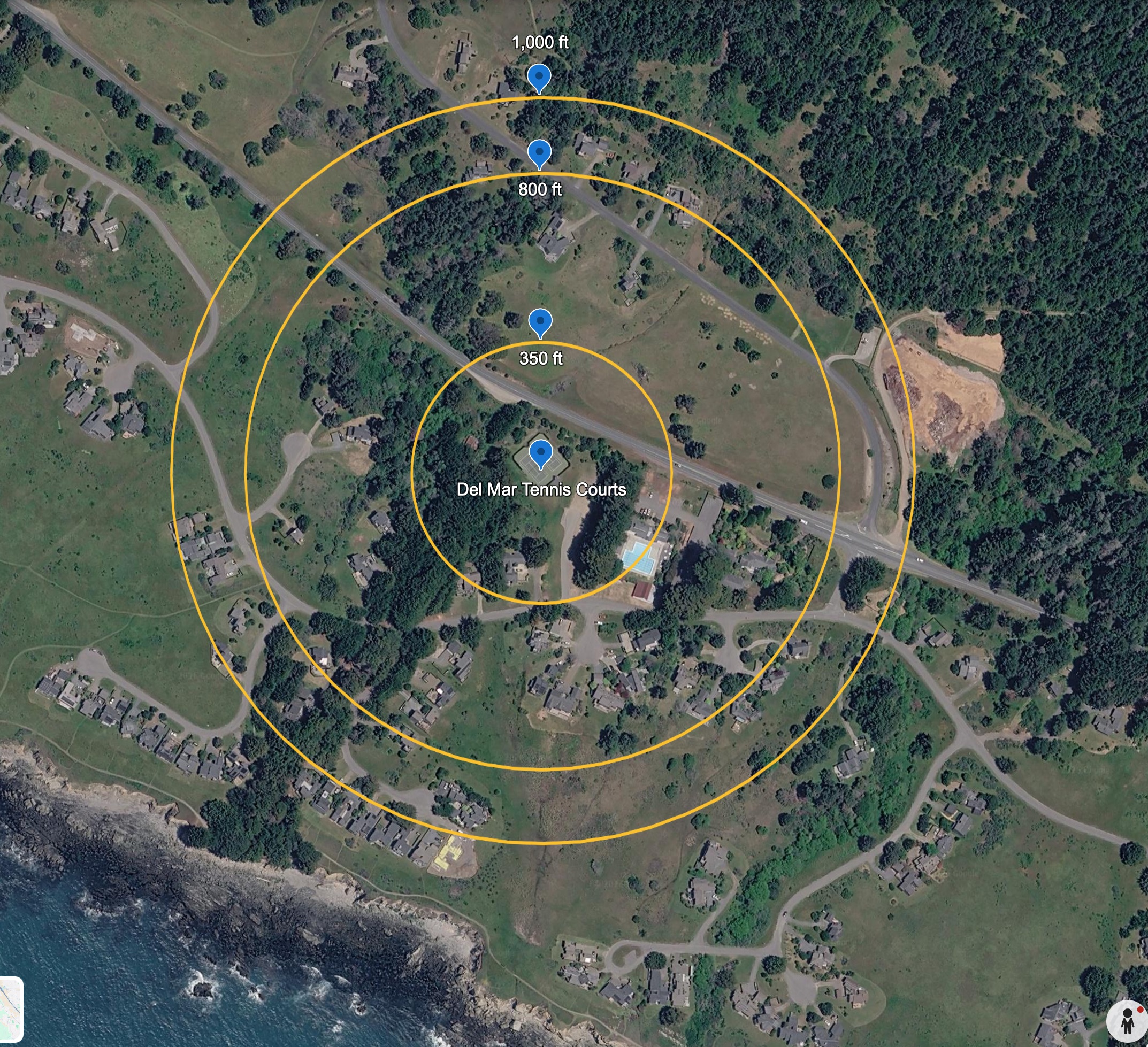
Carmel’s memorandum explains why residential proximity, pickleball’s repetitive sound and local site conditions warrant independent acoustic review before permanent court changes. Her exhibit makes the relationship between the courts and surrounding homes easy to see.
These are mapped distances. They do not predict the sound level at any particular home, establish that every home inside a ring experiences the same impact, or show that effects stop at the outer ring. Terrain, barriers, weather and court activity require site-specific evaluation.
We believe tennis and pickleball are a poor fit at Del Mar. Extra striping, repeated impact noise and the condition of added markings all deserve attention before shared use continues.
Additional court lines create a busier playing surface. The USTA identifies sport-specific facilities as the ideal solution; when courts must be shared, it calls for carefully designed, subdued blended markings. Markings removed fully before tennis avoid that particular visual conflict.
Pickleball’s repeated paddle impacts affect more than nearby homes. USTA Southern documents tennis players’ concerns about pickleball noise during play. Del Mar’s tennis players should not have to accept disruptive noise as the price of access.
Extra markings need a materials-specific safety check: grip when damp, secure attachment and compatibility with the court. Some inappropriate paints can be slippery when wet; proper textured court paint is designed to preserve traction. Temporary tape or strips should never be assumed safe without checking the actual product and conditions.
Noise mitigation deserves careful scrutiny. Members need evidence of performance, enforceability and full costs before relying on it.
A rule is useful only if players follow it and it adequately protects people nearby. Residents, volunteers and other facility users should not have to become equipment inspectors.
Ask who will check compliance, how violations will be handled, and what happens if the promised reduction does not materialize.
Acoustic fencing can reduce sound. Results depend on the site, barrier height, openings and nearby homes. Structural work can make a retrofit expensive.
Lake Elmo, Minnesota received a 2026 estimate of $120,000–$130,000 for replacement fencing and sound-blocking material on all four sides. Staff reported the existing fence could not support the added wind loads.
Lake Elmo staff report, May 18, 2026, pp. 14–15 ↗TSRA’s December 2022 report records solar materials already purchased while Moonraker permitting and other project reviews remained pending. The lesson for Del Mar is straightforward: resolve feasibility before committing further funds.
Members should receive clear answers about required approvals, effectiveness, enforcement and full costs before further spending. A promise to fix problems later is not a substitute for evaluating them first.
TSRA’s December 10, 2022 report, p. 4 ↗Lake Oswego permanently closed pickleball at George Rogers Park in January 2023 after considering mitigation, operating changes and relocation options. Individual cases do not show that all mitigation fails. They show why suitability should be established before relying on corrective measures.
Read Lake Oswego’s project history ↗A home should offer peace and quiet. Persistent court noise can turn prospective buyers away. Resale risk deserves consideration before a community commits to a noise-sensitive location.
The National Association of Realtors reported a Michigan sale where prospective buyers objected to nearby pickleball noise and the home eventually sold below its original asking price. That example does not establish a standard loss in value, but it shows why marketability concerns deserve attention. Protect residents’ enjoyment of their homes and avoid creating a preventable resale risk.
Evidence is mixed and location-dependent. The same NAR article describes another home near courts selling above asking. An appraisal presentation in Lake Bluff reviewed 11 nearby sales and found no apparent depreciation; officials questioned the sales period and missing information about court use and noise mitigation. Neither a small study nor an isolated below-asking sale establishes a general causal effect or a reliable percentage loss. No Del Mar property-value study is presented here.
These are documented closures at particular sites, rather than citywide bans. The records cite noise and neighborhood compatibility. They do not establish that officials proved property-value losses or closed courts specifically to prevent them.
On March 18, 2026, the city permanently discontinued pickleball at Hidden Valley Sports Courts. It cited persistent noise and parking complaints, proximity to homes, and an acoustical expert’s conclusion that feasible mitigation could not adequately resolve the location’s noise impacts.
Official city decision ↗The city prohibited pickleball at Forest Hill Park, while preserving tennis, through an ordinance adopted January 13, 2026. Its earlier staff report documented repeated rule violations and questioned acoustic fencing’s effectiveness where homes sit above the courts.
The city voted January 17, 2023, to permanently close pickleball at George Rogers Park and return the courts to tennis after considering noise mitigation, operating changes and relocation options.
Official project record ↗An August 2025 settlement requires six Willow Lane pickleball courts to become two tennis courts and expressly prohibits pickleball. It resolved a neighboring homeowners’ noise lawsuit without an admission of liability.
Official settlement ↗Support recreation while protecting nearby homes and the people who use Del Mar. Raise your concerns respectfully and ask for a written response.
Read the one-page member handout on neighborhood quiet, tennis access, enforcement, shared costs and the lessons from TSRA’s solar project.
Download the original handout (PDF)Original resident advocacy handout, shared unchanged. The Moonraker figures measure advance booking availability, not attendance. The sound figures are preliminary screening estimates whose methodology has not been independently verified here. The $120,000–$130,000 barrier figure is a municipal comparison, not a Del Mar quote.
October 24 Board meeting: confirm the agenda, time and participation details with TSRA. A pickleball hearing has not yet been independently confirmed here.
Here is a starting point for a member comment. Adapt it to reflect your own experience and concerns.
I support ending pickleball use at Del Mar and preserving its tennis courts. Please evaluate Moonraker’s existing capacity and the full neighborhood impacts and costs before making further permanent changes. Members deserve an approach that supports recreation while protecting nearby homes and other facility users.